Day 0 - Finding Out How Much Maths I Still Remember

I want to move into finance, but when I sat down today to map out a 12-month plan, I kept running into algebraic expressions, mathematical ideas, derivatives, graphs, and lines.
So much of it seemed tied to maths in one way or another and I realised just how rusty my mathematical foundations have become.
So today was about going back to the basics—and discovering how much I actually still remember.
I studied A-level maths in Portugal which meant covering Calculus I and brushing against parts of Calculus II. That was eight years ago, and outside of basic algebra, I haven't touched much of it since.
I also completed the first year of a Computer Science degree, but the first-year syllabus at Coventry University leaned heavily into AI models, Theory of Computation, and algorithms. Topics centred on logic rather than maths or probability.
As I research more, it seems that measuring rates of change is a big part of economic research. If memory serves, that's calculus (derivatives and limits), something I definitely need to work on.
Now that I'm trying to better understand financial markets and how they work, I've had to face reality: I need to revisit these topics and genuinely learn them, not just ignore them.
The stronger my foundation, the higher I can build.
There is no point lying to myself, pretending I know more than I do, or skipping the math I need in order to move forward.
Building a strong mathematical foundation will only make me better equipped for a career in finance down the road. Will it pay dividends? Only time will tell. Either way, I'm highly motivated to keep going.
What I Covered Today
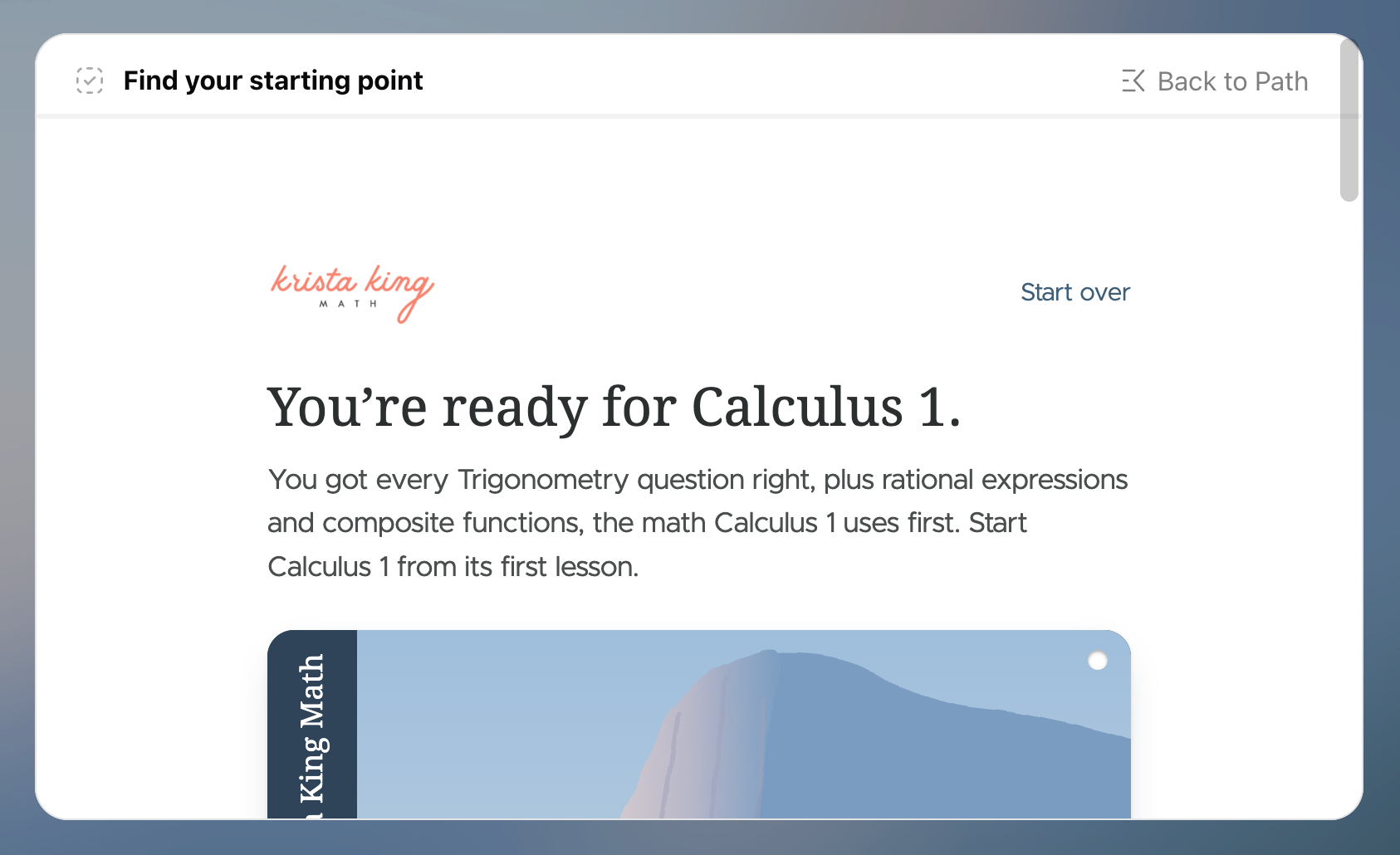
Today I took two short math tests from a maths course provider to gauge where I stand. After a bit of review in trigonometry and algebra, I felt comfortable across Algebra 1, Algebra 2, and trigonometry.
In algebra, I spotted a few gaps where I still need practice like some cases of polynomial division and factoring polynomials.
The books I've chosen
- The Art of Currency Trading, by Brent Donnelly
- Tuckman and Serrat's Fixed Income Securities: Tools for today's Markets
- A History of Interest Rates, by Sidney Homer
And further down the line, Why Not Default by Jerome Roos.
What Next?
I still need to write down the 12-month plan, but now that I know where I stand with maths, I have a better idea of what I should focus on.
As of now, my goal is to continue studying maths, and learn it as I go along studying foreign exchange with Brent Donnelly's book and fixed income with Tuckman and Serrat's book.